



The goal of this article is to describe how leading Space industry experts are addressing the technical challenges and to gain a clear picture of some of the many new competitors in this race to bring space-based data centers to reality.
The topic of AI Data Centers in Space has recently been dominating the news headlines within the Space and AI Tech industries. Jensen Huang of Nvidia recently announced at the development of Vera Rubin Space-1 GPU which is a radiation hardened GPU chip specifically designed to operate in the harsh space environment. In addition to this new “space tolerant” chip development there have been multiple FCC filings for large satellite constellations from SpaceX, Blue Origin, Google and Starcloud to mention just a few. These recent developments have ignited interest in this innovative alternative to terrestrial data centers.
The recent successful SpaceX IPO has really increased the industry chatter and technical acceptance of the reality of Data Centers in Space. Elon Musk has embraced the ODC concept and if you read the SpaceX IPO S1 filling document with the SEC it is obvious that this is a new technology is a central figure in the overall massive IPO valuation of approximately $1.7 trillion dollars. SpaceX and Elon Musk are leading the way and has already published preliminary designs for a satellite specifically designed for space-based orbital data centers. The figure below depicts the basic design for the “AI1” satellite that SpaceX is working on and will be launching sometime in the next couple of years.
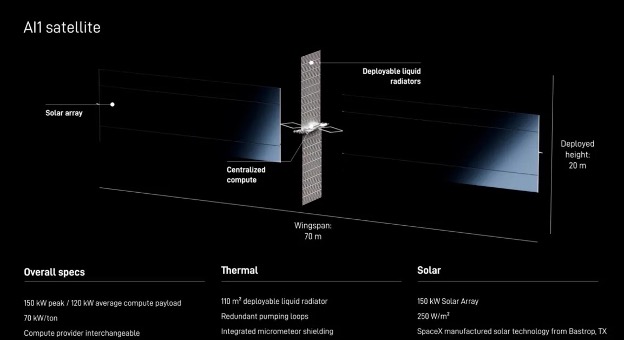
Another major factor increasing support for Orbital Data Centers are the many negative environmental impacts and land use delays surrounding the construction of new terrestrial data centers here on earth. Cities and neighbourhoods in America are fighting back against the expanding land grab for terrestrial data centers which are impacting the quality of life in many local communities. Water usage, electrical grid power consumption, excessive noise and overall environmental issues are accumulating and leading to construction boycotts for many earth-based terrestrial AI data centers. These environmental concerns are paving the way for an alternative option which is space based Orbital Data Centers.
Processing AI data in space has multiple benefits including free and unlimited solar power generation from the sun, no water usage, no connection to local power grids and many other environmental benefits. In addition to the elimination of the environmental impacts with putting data centers in space there are several other commercial and military use cases where processing data directly in space has many benefits. Typically, sensor data that is generated on-orbit is then sent to a ground station on earth to be processed, analysed, and responded to, this round trip from space to earth creates latency delays.
The alternative to this approach is processing sensor or video data directly in space and then downlinking the accumulated results back to earth which is a much more efficient use of this data. The on-orbit sensor data can be anything from adverse weather conditions, wildfire detections, missile launch detections, naval ship movements or other important data where early detection, analysis and response is time critical.
But along with the many benefits there are also many unprecedented technical challenges that need to be resolved before the benefits of this new technology can be realized.
Listed here are just a few of the several technical challenges facing Orbital Data Centers:
- Radiation exposure causing GPU data bit flips and component degradation
- GPU Thermal cooling concerns in the vacuum of space
- On Orbit servicing and replacement of failed GPUs is currently not practical
- ODC’s are currently not cost-effective when compared to Terrestrial Data Centers
The future demand for new AI data centers is increasing exponentially, and the recent Vera Rubin Space-1 chip development from Nvidia and multiple announcements several multi-billion-dollar space companies as well as small startup companies the possibilities of Orbital Data Centers are moving from what was science fiction to reality.
To steal a phrase from the Indianapolis 500, “Gentleman start your engines”, the Race is on for putting AI data centers in space!
